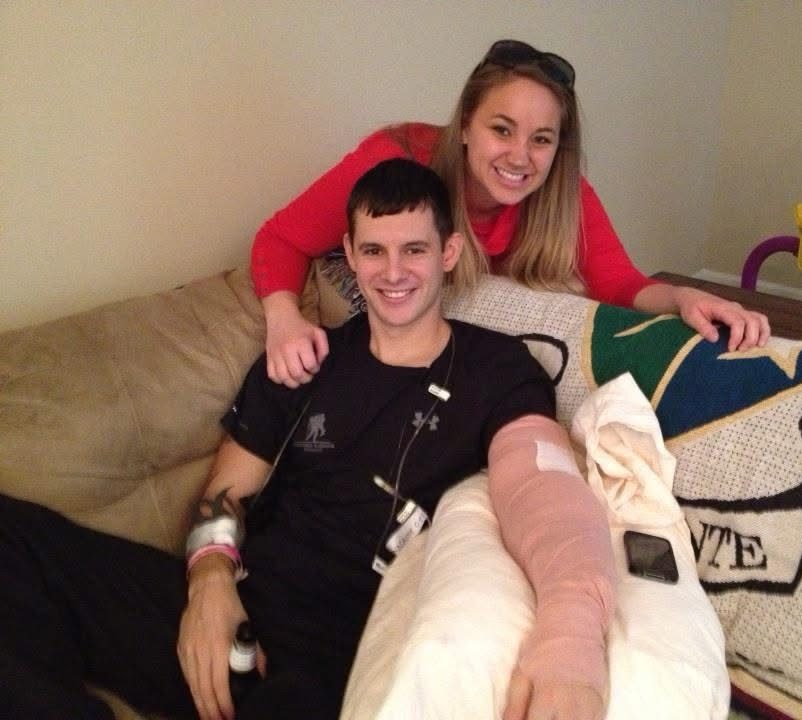
The waiting game continued, but this time we weren’t waiting for surgeries or a medical update. This time, we were waiting for Jeff to come home.
Jeff spent December 5th through the 8th in Landstuhl before he was able to get on a flight home. He’d be coming home on a C-17 equipped like a flying hospital, traveling from Ramstein Air Base in Germany to Joint Base Andrews in Maryland.
Jeff was still in a considerable amount of pain, but the worst came while they were in the air. To this day, he describes it as the worst migraine he’s ever had in his life. He was on some pretty heavy-duty pain medication at the time, and even that wouldn’t touch it. He didn’t find relief until they landed. Knowing what we know now, I still wonder if there was something more going on.
As soon as the plane was on the ground, a team met him on the tarmac and took him to the hospital to get his pain under control. They put in a nerve block for his arm. I’m not sure what they did for the migraine or why it finally went away, but he spent the night at the hospital at Joint Base Andrews before he was able to take another military flight down to Fort Benning.
During this time, I had finally started receiving more up-to-date information about where he was and when his flights were scheduled to arrive. I was also contacted by the nurse case manager who worked with Ranger families. She would end up walking us through this process in one way or another for years. She was the one who called when Jeff’s flight was coming into Fort Benning and told me to meet them at the ER.
His flight landed a little early.
It was early afternoon when Maddie drove me to the hospital to pick him up. When we walked into the ER, Jeff was sitting propped up in a bed, grinning from ear to ear. He looked pale and thin, but what a sight for sore eyes.
This is one of those days I really don’t remember well at all. It’s mostly a blur in my memory, possibly impacted by the sleep aid I was taking at the time. I remember seeing him in that hospital bed, and I remember finally getting him home. Beyond that, pieces are missing.
But he was home.
There wasn’t much time to rest because the next day I had to drive Jeff back to Fort Benning for his first appointment with his nurse case manager.
This was really the beginning of what our life would look like for a while.
He would be starting occupational therapy for his arm and also had appointments with a local orthopedic doctor and a TBI doctor.
That day we met with the orthopedic doctor, and they changed the bandages on Jeff’s arm. To my knowledge, this was the first time his arm had been completely unwrapped since surgery—and the first time either of us had really seen the wounds.
Jeff nearly passed out while they were unwrapping it and had to lie down.
They eventually wrapped his arm back up with fresh bandages, and then we spent the better part of the day at the hospital while they tried to figure out what to do with his nerve block. The Army hospital didn’t use the same kind as the Air Force base in Maryland, and sorting that out took entirely too long.
It was a relief when we finally got home. Occupational therapy began the following day, and Jeff would be going several times a week.
We also met with a TBI doctor that week. To the best of my memory, they asked a lot of questions and gave Jeff a list of dos and don’ts.
And that was about it.
At least, that’s how it felt to me then.
The arm was the thing we could see. It had wounds and bandages and hardware. It required surgeries, appointments and hours of occupational therapy. There was an obvious problem in front of us that needed to be fixed.
The brain injury wasn’t nearly as easy to see, and I don’t think either of us understood yet how big of a deal it would eventually become.
It’s hard looking back now and wondering if we missed a window of time that was so important for healing. There was so much we simply didn’t know, and I can’t help but wonder if some of what we didn’t know then is part of the reason we’re still working on this today.


Leave a Reply