Finding ways to improve Jeff’s brain injury had never completely left our radar. We just didn’t really know what else to do.
Through the years, the topic of HBOT (Hyperbaric Oxygen Therapy) for brain injuries would come up, and we’d discuss it, but we didn’t know where—or how—he would do it. In many ways, it’s still considered a nonconventional treatment option for TBIs. It definitely wasn’t something his doctors had ever discussed with us, but the more Jeff learned about it through certain veteran communities, the more interested he became.
Eventually, he started bringing it up more and more. There was an excitement he had about the possibility that this might actually help him.
I have to admit, I was skeptical.
It wasn’t that I thought it was a bad idea. I just wasn’t as convinced as Jeff was that we would see the kind of changes he was hoping for.
We didn’t even know anyone personally who had gone through this kind of treatment. Jeff continued reading studies that had been done and stories from people with TBIs who had symptoms similar to his and said treatment had improved their symptoms and quality of life. Committing to Jeff being gone for a month when I wasn’t certain what the outcome would be made it harder for me to share his excitement.
But I also knew that if he had the opportunity, he should do it.
He has always been an extremely hard worker, and I knew that if someone was going to fully commit to this and put in the work, it would be him. More than anything, I didn’t want us to spend the rest of our lives wondering, What if?
Jeff’s third arm surgery had essentially been a Hail Mary attempt, and that exceeded all of our expectations—even surprising his doctor. So why couldn’t this?
So off to Florida he went.
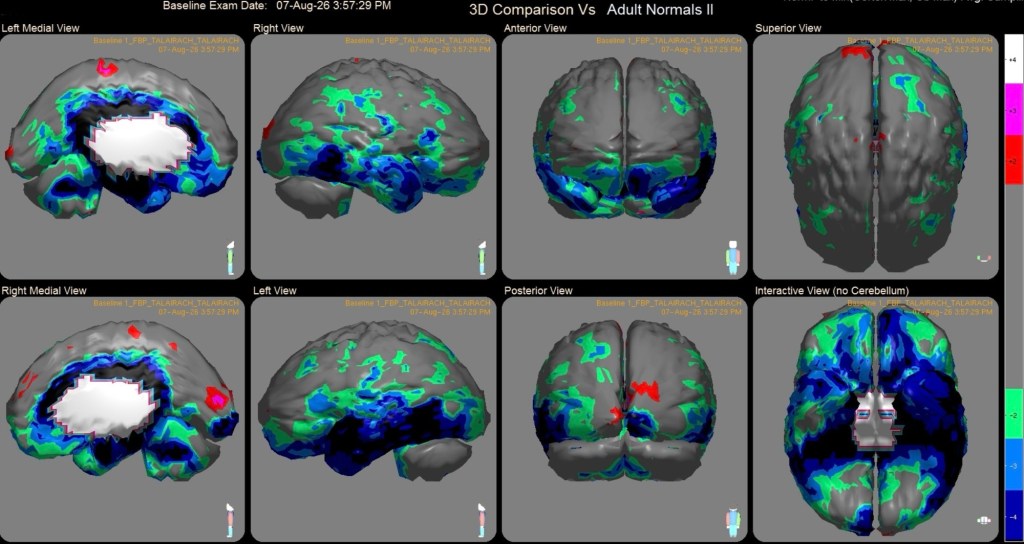
Once Jeff arrived in South Florida, before beginning treatment, he had SPECT scans done on his brain. These gave us a different look at his brain than we had ever had before.
I’m going to do my best to explain this the way it was explained to me, so bear with me as I attempt to translate medical information into normal-person language.
Jeff’s scans were compared to what would be a “normal brain” of someone his age. On the images, gray represents the normal function. The areas that move from green to light blue, dark blue and eventually black show progressively more significant areas of decreased blood flow and activity.
Even though Jeff had a good bit of dark areas on his scans, the silver lining for me was hearing that none of those areas were necrotic. We were told they believed the affected areas still had the ability to regenerate.
I needed to hear that.
Seeing the scans for the first time was a little overwhelming because there was so much more affected than I had expected to see. For years, we had thought of Jeff’s injury primarily as a frontal lobe injury. These scans showed us that the affected areas included the front, back and sides—particularly the left side—as well as the bottom and deeper areas of his brain.
We went on to learn more about the specific parts of Jeff’s brain that were affected and what those areas are responsible for. That really did give us a better understanding of what makes Jeff, Jeff these days. But that’s a little too much to try to squeeze into this post for now.
The scans were only part of his initial workup. Jeff also had blood work done because TBIs are often associated with hormone imbalances, so it was important to get to the bottom of any of those issues as well.
While he waited for those results, he started HBOT. He did two sessions a day, five days a week, for four weeks—a total of 40 dives.
I wanted this explained to me like I was five, so the simplest way I understood the goal was to try to wake up some of those sleepy or underactive areas we could see on his brain scans.
HBOT was the main focus of the month, but it definitely wasn’t the only thing Jeff was doing.
We also had encouragement from a friend for Jeff to do exercises on his own to help form new neural pathways while he was going through treatment. This could be in the form of little brain exercises or even doing puzzles or games.
In between his HBOT sessions, he went to a chiropractor, did balance therapy intended to help with neuroplasticity, and had cryotherapy, compression therapy, red light therapy and infrared sauna sessions throughout the month.
Even though he was away from home and completely out of his normal routine, he still tried to eat healthy and exercise two to three times a week.
It’s still too early to know exactly what all of this will mean for Jeff long term. I don’t think there was ever going to be one month of treatment that suddenly erased almost 14 years of living with a brain injury.
We decided to wait about four months before doing his post-treatment SPECT scans. We could have done them sooner, but we’re hoping that giving his brain more time after treatment will give us a better picture of any changes that may be happening.
So in some ways, we’re still very much in the wait-and-see part of this.
In the meantime, we’ve come up with a plan to support him and continue building on any progress he made while he was away.
But I do think we came home with something we didn’t have before—a much better understanding of Jeff’s brain, some new things to work on, and a little more hope that maybe we don’t have to simply accept everything as the way it will always be.
For now, we’re figuring out what comes next.


Leave a Reply