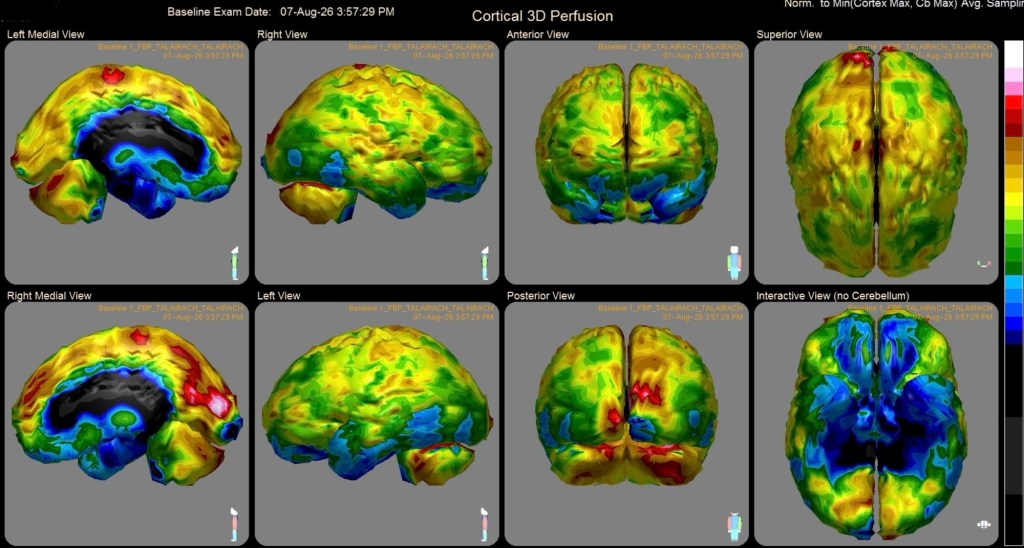
My first thought when I saw Jeff’s SPECT scans was honestly, they look so pretty, which was very quickly followed by, “Okay, focus Ali. Don’t get distracted by the pretty colors.” But blue and green are my favorite colors, so I really didn’t stand much of a chance.
I’ve restarted this post more times than I want to admit because the more I learn about these scans, the harder it is to figure out what actually belongs here. There is a lot to them, there is still a lot I don’t completely understand, and every answer seems to give me about five more questions.
Pretty colors aside, after years of thinking about Jeff’s brain injury as simply—and I do use that word lightly—a frontal lobe injury, these scans were eye-opening for me. I’ve seen other images of Jeff’s brain over the years, including MRIs, but they never really meant much to me because I didn’t understand what I was looking at. The SPECT scans felt different because they gave us a 3-D look at blood flow throughout his brain and showed areas where blood flow was decreased.
Even before I fully understood what I was looking at, the darker areas stood out to me. It was the first time I really stopped and thought about how much more could be going on than I had understood all these years.
I’m still learning as I go, so I’m not trying to turn this into a medical journal or say that one dark area on Jeff’s scan definitely caused one specific symptom. I am looking at Jeff’s actual report and scans while I write this, along with my notes and the things that were explained to us. I’m just trying to make sense of it and pull out the parts that seem most relevant to what we’ve actually seen in Jeff over the years. There are other findings and things we’ve learned that I’m leaving out for now and may come back to later.
According to Jeff’s report, some of the most significantly affected areas were the temporal and parietal lobes, especially on the left side. There was also decreased perfusion in the frontal and occipital lobes and significant decreased perfusion in the cingulate gyrus. That was already a much bigger picture than the frontal lobe injury I had carried around in my head for almost fourteen years.
One of the terms I’ve learned through all of this is coup-contrecoup. The easiest way for me to picture it is almost like a less severe mirror image of the injury showing up on the opposite side of the brain.
With Jeff, we could see that kind of pattern from left to right, but also from back to front. The left-to-right pattern made the most sense to me because Jeff’s most significant physical injuries from the blast were on the left side of his body, and some of the findings on his brain scans were also worse on the left. That feels very consistent with the blast injury we already know happened.
The back-to-front pattern gave me more questions, although that could absolutely be part of the blast too since we don’t know exactly how his body moved or how he landed. It’s just one of those things that reminds me not to try to make every dark area fit into one neat explanation.
As far as the specific areas affected, the temporal lobes were among the most significantly affected. Memory problems can be associated with this part of the brain, which obviously stood out because memory has been one of Jeff’s biggest struggles. Mood regulation and irritability can also be affected, which we’ve definitely seen over the years, although I think that was worse early on. It can also affect language, which made me think about the times Jeff knows what he wants to say but has trouble finding the right word.
The parietal lobes are involved in attention and sensory processing, and that felt familiar too. Attention has been an issue, and sensory overload is something we deal with regularly. Noise, too much going on around him, or too many things happening at once can become a lot.
The frontal lobe was the part I already knew about. It plays a big role in focus and executive functioning—planning, organizing and actually carrying out a task. Jeff is absolutely capable of doing things, but sometimes it takes more effort to get from knowing something needs to be done to figuring out the steps and getting it done.
The cingulate gyrus stood out because changes there can be associated with getting stuck in thought patterns, ruminating and being inflexible. There is more I want to come back to here, especially as I learn more about stress response, hypervigilance and something I was told about called the “PTSD Diamond.” There’s enough there that I think it deserves its own space later.
Jeff’s occipital lobe also showed decreased perfusion. That area is involved in vision, and as far as I know, Jeff hasn’t had symptoms we would connect to it. I still think it’s worth mentioning because not every affected area on a scan comes with an obvious symptom we can point to.
Something else I didn’t fully understand before is that not every dark area has to come from physical trauma. Other things can affect blood flow to the brain too, including toxic exposures, certain medications and low oxygen over time.
That immediately made me think about Jeff’s sleep apnea diagnosis. I’m not saying sleep apnea caused any specific area on his scans because I have no way of knowing that, but if his brain already had areas showing decreased blood flow, it makes me wonder what years of poor-quality sleep and drops in oxygen at night may have added to the picture.
That’s really where all of this has started to change the way I look at Jeff’s brain injury. The blast clearly explains part of what we’re seeing, but I’m not sure anymore that it explains all of it.
Jeff spent years in a Special Operations unit with repeated training cycles, jumps out of airplanes carrying heavy equipment, blast exposure, lack of sleep, high physical stress and everything else that came with that job. I can’t tell you which of those things affected his brain, or if some of them did at all, but I think we have to at least look at the whole picture.
I’ve also recently started learning about something called Operator Syndrome, which looks at some of the cumulative effects years in Special Operations can have on the brain and body. Brain injuries, chronic stress, sleep, hormones and other physical changes can all be part of that conversation. I’m only beginning to understand it, but it makes me wonder if we may eventually connect some dots we didn’t even know belonged together.
For almost fourteen years, I mostly thought of Jeff’s brain injury as a frontal lobe injury from one blast. I don’t think I can look at it that simply anymore.
Some of what we saw on these scans makes things we’ve lived with for years make a little more sense. Other parts have given me completely new things to learn about, and there are still pieces—stress, hormones, sleep, his years in Special Operations and everything else that may have piled on over time—that we’re only beginning to understand.
So no, I definitely don’t have this all figured out. I’ll probably come back to some of it later and realize I understand it differently than I do today, and I’m okay with that. Right now I’m just trying to take what we’re learning and compare it with what we’ve watched Jeff deal with for almost fourteen years.
We went looking for more answers. We got some.
Apparently, we also got a whole new list of questions.


Leave a Reply